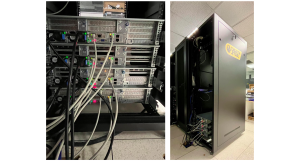


Deathstar is a high-performance computing (HPC) infrastructure built in 2025 as an initiative by researchers of the INF-ACT Foundation (Prof. Baldanti, Prof. Bruno, Prof. Mondelli and Prof. Sassera). The system was developed to support advanced infectious disease research through large-scale computational and bioinformatics analyses.
Deathstar provides a total of 256 CPU cores distributed across four compute nodes, including both high-memory and GPU-accelerated nodes. Its architecture enables efficient execution of memory-intensive and compute-intensive workloads commonly required in infectious disease research.
Deathstar supports demanding downstream analyses such as:
- Whole-genome sequencing analysis
- Variant calling pipelines
- High-throughput read mapping
- Phylogenetic and evolutionary analyses
- Protein structure predictions
- AI- and GPU-assisted bioinformatics applications
With dedicated GPU resources and terabyte-scale memory nodes, the infrastructure is optimized for large datasets and parallelized computational workflows.
Key Features
- 256 CPU cores across four compute nodes
- 2 TB total RAM across dedicated high-memory nodes
- GPU acceleration with two NVIDIA RTX A6000 and four RTX A4500ada GPUsA4500
- Managed through Slurm Workload Manage
- Over 100 TB of available storage